
Exploring the connections between Park Jae Woo’s Triorigin philosophy, ancient wisdom and the creative dynamics of life.
I recently came across the work of Professor Park Jae Woo (1942–2010), a Korean thinker and healer best known for developing Su Jok Therapy. What caught my attention was the philosophy that he developed to explain the fundamental workings of the universe.
He called it Triorigin, and as I explored it, I was struck by how closely some of his insights resonated with what I have been developing through my own work on Volution.
There is something fascinating about discovering that someone working in a completely different cultural and intellectual tradition has arrived at ideas that feel remarkably familiar. It raises the possibility that we may be looking at different expressions of some underlying patterns of life.
From the hands to the universe
Park began with the human body. His Su Jok Therapy, developed in the 1980s, is based on the idea that the whole body is reflected in miniature in our hands and feet. By stimulating particular points, he believed it was possible to influence corresponding parts of the body.
Whether or not the therapeutic mechanisms he proposed can be scientifically demonstrated, the underlying idea is very recognisable: the whole is reflected in the parts.
This is a principle found in many wisdom traditions. The ancient Hermetic understanding of the relationship between microcosm and macrocosm suggests that patterns operating at the level of the universe are also present within the human being. The seventeenth-century philosopher Robert Fludd explored this extensively in his extraordinary illustrations of the relationship between humanity, nature and the cosmos.
Park’s thinking developed in a similar direction. He began asking whether the patterns he believed he was observing in the body might reflect more fundamental principles operating throughout existence. This led him to Triorigin.
Four forces behind creation
At the heart of Triorigin are four fundamental principles that Park believed shape everything in existence.
The first is Neuto, representing the original state of wholeness and pure potential, before anything has differentiated into distinct forms.
Then come two contrasting forces.
Hetero is the force of change, expansion and differentiation. It drives things to move, develop and become different from what they were before.
Homo is the force of stability, contraction and similarity. It holds things together, maintains their identity and allows coherent forms to exist.
Finally, there is Neutro, the principle that brings these forces into a creative relationship. Neutro enables their differences to work together in a way that generates harmony and development.
Think of an oak tree. A tree needs stability. Its roots anchor it, its trunk maintains its structure, and its cells preserve the organisation that makes it recognisably an oak rather than a willow. This reflects the principle Park called Homo.
Yet the tree also needs to change. It grows new branches, responds to sunlight, produces leaves and adapts to the seasons. This is Hetero.
If stability completely dominated, the tree would stop growing. If change completely dominated, it would lose its coherence and fall apart. Life happens through the creative relationship between the two. That is where Neutro comes in.
Behind the whole process lies the original potential from which the tree emerged, represented by Neuto.
The connection with Volution
In my book Volution – A Philosophy of Reconnection, I explore the possibility that creation is not simply a linear process moving from past to future. Instead, I propose that life is an ongoing process of coming into form and returning to potential. Evolution and involution are two aspects of one continuous creative movement.
I have come to understand this through three fundamental aspects of reality: Container, Manifest and Dynamics.
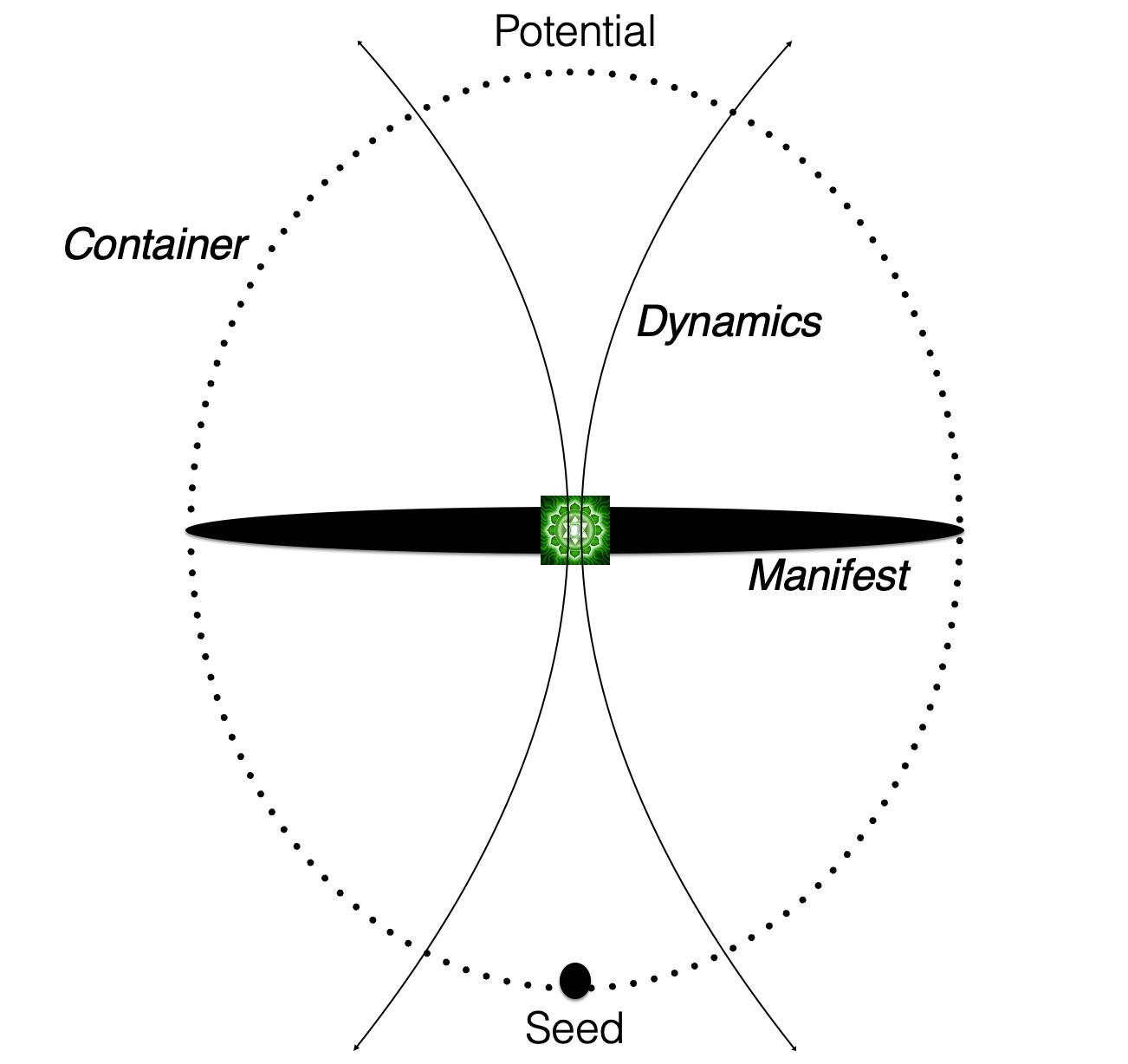
Container is the larger wholeness or field of potential within which something exists. Manifest is the particular form that emerges within that field. Dynamics is the living relationship between them.
A seed, for example, contains the potential for a tree and is connected to the subtle information of that type of tree. The tree that eventually grows is the manifested form. The process through which the potential becomes actual, shaped by its relationship with soil, water, sunlight and the wider ecosystem, is the dynamic.
Yet the mature tree is not the end of the story. It produces new seeds, participates in a forest, becomes home to other forms of life, and eventually returns its material to the wider ecosystem. Each whole is also part of something larger. Each ending is involved in new beginnings. I call this ongoing, interconnected creative movement Volution.
When I encountered Park’s Triorigin, I immediately recognised some important similarities. His Hetero and Homo resemble the movements of expansion and contraction that are central to Volution. His Neuto points towards the originating wholeness from which creation emerges. And Neutro resembles the creative dynamic through which apparent opposites generate something new.
There are differences too. We can’t simply equate Park’s four principles with the three aspects of Volution. In particular, the dynamic relationship in Volution is present throughout the creative process, rather than arriving as a separate force after differentiation.
Nevertheless, both perspectives suggest that creation depends on the relationship between wholeness, difference and the forces that connect them.
The creative power of opposites
One of the themes I have explored repeatedly in Volution is that polarity is essential to creation. We often experience opposites as problems to be resolved. Stability versus change. Individuality versus community. Freedom versus responsibility. Tradition versus innovation.
Our instinct is frequently to choose one side and fight the other. But what if the tension between them is precisely where creative potential lies?
Consider an organisation. It needs enough structure to maintain its identity, fulfil its commitments and operate effectively. But it also needs sufficient freedom to innovate, respond to changing circumstances and discover new possibilities. Too much stability and it becomes rigid. Too much change and it becomes chaotic. The most creative organisations find ways to hold both tendencies in a productive relationship.
This is different to compromise. A compromise often means each side giving something up. Creative integration can produce possibilities that neither side could have imagined independently.
In Volution, I understand this as part of the fundamental creative dynamic between present reality and future potential. What currently exists establishes the conditions within which change is possible. What could emerge draws the system towards new possibilities.
The actual constrains the possible. The potential influences the probable. Their relationship generates the trajectory of becoming.
Park’s concept of Neutro offers another language for understanding this generative relationship.
An ancient insight appearing again
Park and I are far from the first people to explore such ideas.
Alchemy, for example, placed great importance on the union of opposites. The alchemists worked with the symbolic relationship between the Sun and Moon, the fixed and volatile, separation and union. Transformation was understood to involve bringing apparently conflicting principles into a new relationship.
Robert Fludd’s Hermetic cosmology explored how invisible potential becomes visible form through a universe structured by correspondence and harmony. His famous World Monochord portrayed the cosmos through musical relationships, connecting different levels of existence into one coherent whole.
In Eastern traditions, the relationship between yin and yang expresses a similar insight: complementary tendencies continually give rise to and transform one another. The indigenous Northwest European tradition of Wyrd talks about the dynamic between Fire and Frost.
These traditions emerged in their own historical and cultural context, and we should be careful not to force them into a single system. At the same time we can’t ignore the recurring patterns. Again and again, we find descriptions of an originating unity, the emergence of polarity, the relationship between apparently opposing forces, and the generation of new forms of wholeness.
In Volution, I have tried to bring these insights together with perspectives from systems thinking, developmental theory and contemporary scientific research, while recognising the important differences between philosophical models and experimentally established explanations.
The whole in every part
There is one further connection. Park’s original insight behind Su Jok was that the whole body is somehow represented within smaller parts of itself. Volution also proposes that the same fundamental creative dynamics operate at different levels of reality.
A cell exists within an organ, an organ within a body, a body within an ecosystem, and an ecosystem within a planetary whole. Each has its own coherence while participating in something larger. I describe these nested relationships as holarchies, building on Arthur Koestler’s work: wholes that are simultaneously parts of greater wholes.
The process of Volution repeats throughout these nested levels. What I have called the holographic breath is the continuing movement between potential and manifestation, It suggests the philosophical possibilit that creation may express recognisable organising patterns across different scales.
If that is the case, understanding those patterns could help us make sense of our own lives, relationships and collective development.
An interesting difference
There is also an interesting distinction between Park’s Triorigin and Volution.
Park’s philosophy places considerable emphasis on harmony and perfection as purposes of existence. His later work on Smile Meditation reflects his conviction that the deepest nature of reality is connected with an original state of harmony and joy.
In Volution, I tend to emphasise the ongoing and open-ended character of creation. When opposites come together creatively, they tend not to return to the state from which they emerged. Their relationship can generate an entirely new level of existence, with new possibilities and new tensions.
A seed becomes a tree. A tree participates in a forest. A forest shapes an ecosystem that makes new forms of life possible. The process continues. In other words, integration does not mark the end of polarity. It creates the conditions for new polarities to emerge at another level.
This is one of the reasons I find the image of breathing so helpful. Each breath is complete in itself, yet it belongs to a continuous process. Life does not arrive at a final inhalation or exhalation. It lives through the movement between them.
What might this mean for us?
For me, the value of these ideas is in how they change the way we engage with life.
If we understand difference as something essential to creation, rather than a threat to wholeness, we might approach our disagreements differently.
If we recognise that stability and change are both necessary, we might become less attached to one and less fearful of the other.
If we understand ourselves as whole beings participating in larger living systems, we might take our relationships with other people and nature more seriously.
And if we recognise that the tension between what exists and what is possible is part of life’s creative process, we might become more willing to stay present with uncertainty rather than rushing to eliminate it.
This is particularly relevant at a time when so many of our social, ecological and political challenges seem characterised by increasing polarisation. We do not need to eliminate our differences to create a better future. We need to discover how to engage with them in ways that generate something more coherent and life-giving.
Different paths, a common pattern?
I find it heartening to encounter another thinker who has approached the mystery of creation from such a different starting point and arrived at a framework with these intriguing similarities.
Park began with healing and the human body. My own journey began with leadership, human development, consciousness and the relationship between energy and form. The similarites suggest some worthwhile questions.
What if wholeness and differentiation are not opposites, but mutually necessary aspects of creation?
What if the tension between stability and change is not something to overcome, but a fundamental source of life’s creativity?
And what if we could learn to participate more consciously in that creative process, in ourselves, our organisations and our societies?
These are the questions that continue to drive my exploration of Volution.
Further reading
- Park Jae Woo’s work is explored in Massimo Laganà’s Correspondence Systems, Theory of Energies, Triorigin World and Smile Meditation, published in AGON (2019).
- The Smile Triorigin Academy’s introduction to Triorigin presents the philosophy as understood by contemporary followers of Park’s work.
- For more on my own framework, see Volution – A Philosophy of Reconnection.
- My earlier piece, From Evolution to Volution, explores the origins of the framework and its connections with polarity, geometry and the creative process.